
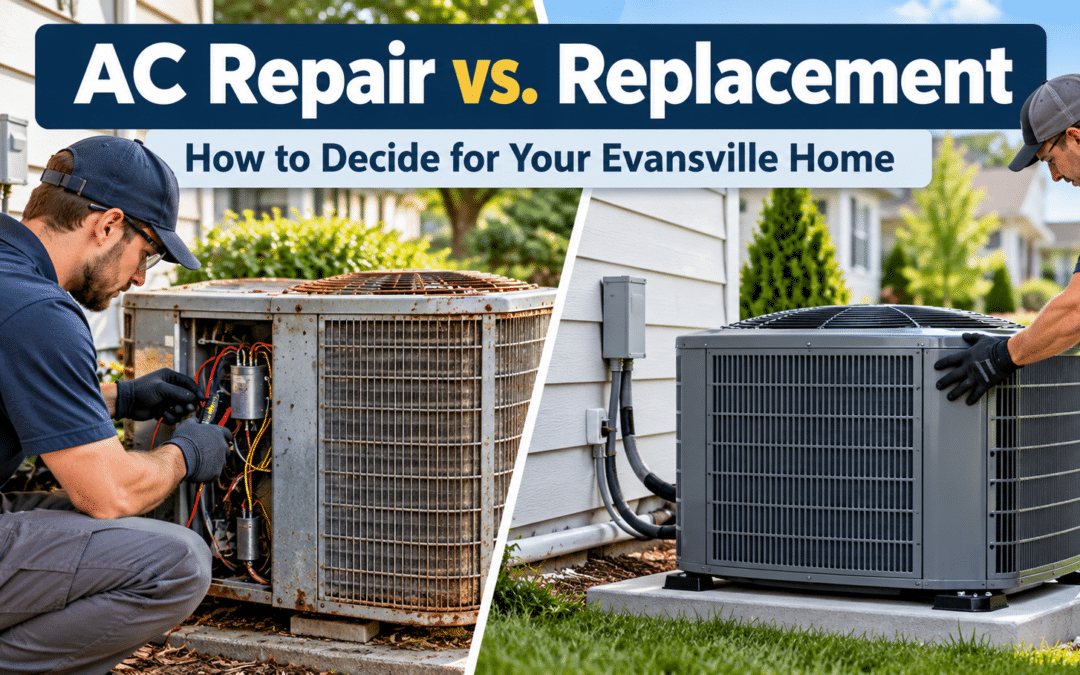
When an air conditioner breaks down, the biggest question is often whether to pay for a repair or invest in a replacement. There is no single rule that fits every Evansville home. A good decision weighs the system’s condition, the cost and scope of repairs, comfort, efficiency, and how long you expect to stay in the home.
Start with the diagnosis—not a rule of thumb
An AC that stops cooling may need a relatively straightforward repair, or it may have major component damage. Ask for a written diagnosis and an itemized estimate. The technician should explain what failed, whether other issues are visible, and what the repair is expected to accomplish. Avoid replacing equipment solely because it has reached a particular birthday.
Consider the air conditioner’s age and repair history
Older systems may be less efficient and some parts can become harder to obtain. However, age alone does not tell you whether a repair is poor value. Consider how often the unit has needed service in the last few seasons, whether the same issue keeps returning, and whether the equipment has been maintained.
Compare the full costs
Compare a reasonable repair estimate with a replacement quote that includes equipment, labor, any necessary electrical or duct adjustments, permits if applicable, and disposal. Ask about warranties and what is—and is not—included. A cheaper upfront fix may be appropriate if the rest of the system is sound. A major repair on equipment with multiple ongoing problems may change the calculation.
Pay attention to comfort and operating performance
Do some rooms stay hot even when the AC runs? Does the equipment cycle frequently? Are noise or humidity problems becoming more noticeable? These symptoms may reflect the AC itself, but ductwork, airflow restrictions, controls, or sizing can also be involved. A replacement without investigating the underlying problem might not solve it.
Think about efficiency without assuming savings
Newer, properly selected cooling equipment can use less energy than older equipment, but actual savings depend on the home, local weather, equipment efficiency, installation quality, thermostat settings, and usage. Ask for an explanation of efficiency ratings and the assumptions behind any savings estimate. Avoid treating advertised percentages as a personal guarantee.
Ask about sizing and installation quality
The right replacement is not necessarily the same capacity as the old system. The home’s insulation, windows, orientation, layout, and duct condition can influence the cooling load. Ask whether your contractor will evaluate system sizing and inspect the ductwork rather than simply swapping boxes.
Five questions to ask before approving work
- What failed, and how was the problem diagnosed?
- What does the repair estimate include, and is there a warranty?
- Are other major components in good condition?
- If replacement is proposed, how will the equipment be sized?
- What is the estimated total installed cost and expected benefit?
Residential AC service in Evansville
Evansville Heating and Air Conditioning offers residential cooling repair and installation. Visit our residential HVAC services page to review the company’s services, or contact us to discuss your options at (812) 618-2659.
Look at repair risk, not only today’s price
A repair quote and a replacement quote answer different questions. The repair quote covers a known problem today; a replacement quote is an investment in a different system with a new installation and warranty structure. To compare them fairly, ask whether the rest of the old equipment is functioning well. A single faulty component on an otherwise dependable unit presents a different decision from multiple failures over several summers.
Keep a basic history of service calls, parts replaced, and the amount of time the home has spent without cooling. The records will not predict exactly when equipment will fail, but they help you avoid judging the system solely by the most recent bill. If you expect to sell the home soon, your goals may also differ from those of a homeowner planning to stay for another decade.
Why the cheapest replacement quote may not be the best value
Two installation quotes can look similar while covering very different work. One may include evaluation of existing ductwork, new controls, electrical adjustments, or removal of old equipment, while another excludes them. Ask whether the quoted model matches your heating system and whether any parts of the existing system are being retained. Compatibility matters when replacing only one component of a split system.
Also ask how the contractor will confirm that the equipment is sized appropriately for the house. An oversized unit can cycle frequently and may not handle moisture as expected; an undersized one may struggle at peak load. Your home’s insulation, windows, additions, and air leakage may have changed since the old equipment was installed. A thoughtful sizing discussion is more useful than simply requesting the largest unit you can afford.
Consider the real comfort problem
Homeowners sometimes begin shopping for a new AC because one bedroom never cools. Yet the source of the problem could be duct leakage, an obstructed return, an insulation gap, or unusual afternoon sun exposure. If those issues remain after equipment replacement, the uncomfortable room may stay uncomfortable. Ask the contractor to explain whether the proposed replacement will actually address your complaint.
Humidity deserves the same attention. A home that feels sticky may need more than a lower thermostat setting. Controls, airflow, equipment capacity, and building conditions can influence how effectively a cooling system manages moisture. State your comfort goals clearly rather than assuming a new system automatically solves every issue.
Questions worth asking about warranties and financing
Ask for warranty terms in writing and distinguish equipment coverage from labor coverage. Does the warranty require registration or scheduled service? Are there exclusions you should understand? If financing is offered, compare total borrowing cost, repayment term, and conditions rather than looking only at the monthly payment. Do not assume every promotion, rebate, or tax incentive applies to your situation; eligibility and program rules change.
A replacement decision should feel understandable when the conversation ends. You should know the reason for the recommendation, the options available, what work is included, and what follow-up to expect. If any of these points remains unclear, ask for clarification before authorizing the job.
A practical decision example
Imagine an older air conditioner that recently needed a modest electrical repair, has otherwise cooled reliably, and keeps the house comfortable. Repair may be sensible after a proper diagnosis. Now consider another system with recurring breakdowns, poor comfort, and a costly major-component failure. Replacement may deserve more consideration. These examples are not formulas or price thresholds; the details of the actual system still decide the answer.
For Evansville homeowners, the aim is not to replace every aging system or keep repairing equipment forever. It is to choose an option that addresses the diagnosed problem, fits your budget, and provides reasonable comfort for the years ahead.
Frequently asked questions
Q? Is a 10-year-old AC automatically due for replacement?
A. No. Age is one factor; condition, repair cost, maintenance history, efficiency, and comfort all matter.
Q? Does a new AC always fix uneven cooling?
A. Not necessarily. Uneven cooling can also come from duct, insulation, airflow, or thermostat-related issues.
Q? Should I get a written estimate?
A. Yes. Written repair and replacement scopes make it easier to compare costs and understand exclusions.
Evansville Heating And Air Conditioning
https://maps.app.goo.gl/D7tMzVR6FDK5okjM9
5625 Pearl Dr. Suite F Box 200 Evansville, IN 47712
(812) 618-2659
https://evansvilleheatingandair.com/